
Robert Pattinson is James Bond.
There. We said it. After years of speculation, countless betting slips and enough casting rumours to keep MI6's intelligence analysts occupied for a decade, the next chapter of cinema's most famous secret agent finally has its leading man.
The announcement on 16 November 2026 confirmed that Pattinson will succeed Daniel Craig, with Denis Villeneuve directing and Steven Knight writing the next instalment.
A fresh Bond, a new creative team and, presumably, another opportunity for someone to drive an extraordinarily expensive Aston Martin into something solid.
Naturally, the internet has opinions.
Can Pattinson carry the sophistication of Connery? The humour of Moore? The physical intensity of Craig? Will his Bond be darker, younger, more vulnerable or simply better at ordering a martini without sounding painfully self-conscious?
All perfectly reasonable questions.
But here at The Wind Up, we have a rather more pressing concern.
What on earth is he going to wear on his wrist?
Because while everyone else is discussing the actor, the director and the inevitable return of the opening gun-barrel sequence, we'd argue that Bond's wristwatch deserves a seat at the same table.
In fact, we'll go a little further.
The watch in a James Bond film can be every bit as important as the actor playing him, the storyline carrying him or the car getting him out of trouble.
Ridiculous? Perhaps. But hear us out.
Over more than six decades, Bond has worn watches that reflected the technology, fashion, politics and aspirations of their time. Some were magnificent mechanical instruments. Others were digital curiosities that looked like miniature office equipment. A handful doubled as weapons, communication devices or emergency escape mechanisms.
And occasionally, a watch did nothing more than tell the time.
Which, rather disappointingly for Q Branch, is exactly what a watch is supposed to do.
Yet each one contributed something to the Bond identity.
So, with Pattinson preparing to inherit cinema's most recognisable dinner jacket, we're looking back at the ten watches that helped define the world's most famous spy.
Not necessarily the ten most expensive. Not simply the ten most technically accomplished. And certainly not the ten watches with the largest marketing budgets.
Our ranking considers two things: how good the watch actually is, and how important it has become to the James Bond franchise.
Each receives a score out of ten for watchmaking merit and another for Bond significance, with equal weighting. These are editorial judgements, not laboratory measurements.
Because a magnificent watch that nobody remembers seeing in a Bond film is only half the story.
And a gloriously ridiculous gadget that saves the world might deserve more recognition than its modest movement suggests.
Right then, Mr Bond. Shall we?
10. Hamilton Pulsar P2
Live and Let Die (1973)
Bond: Roger Moore
Watch rating: 7/10
Bond significance: 6/10
Overall: 6.5/10
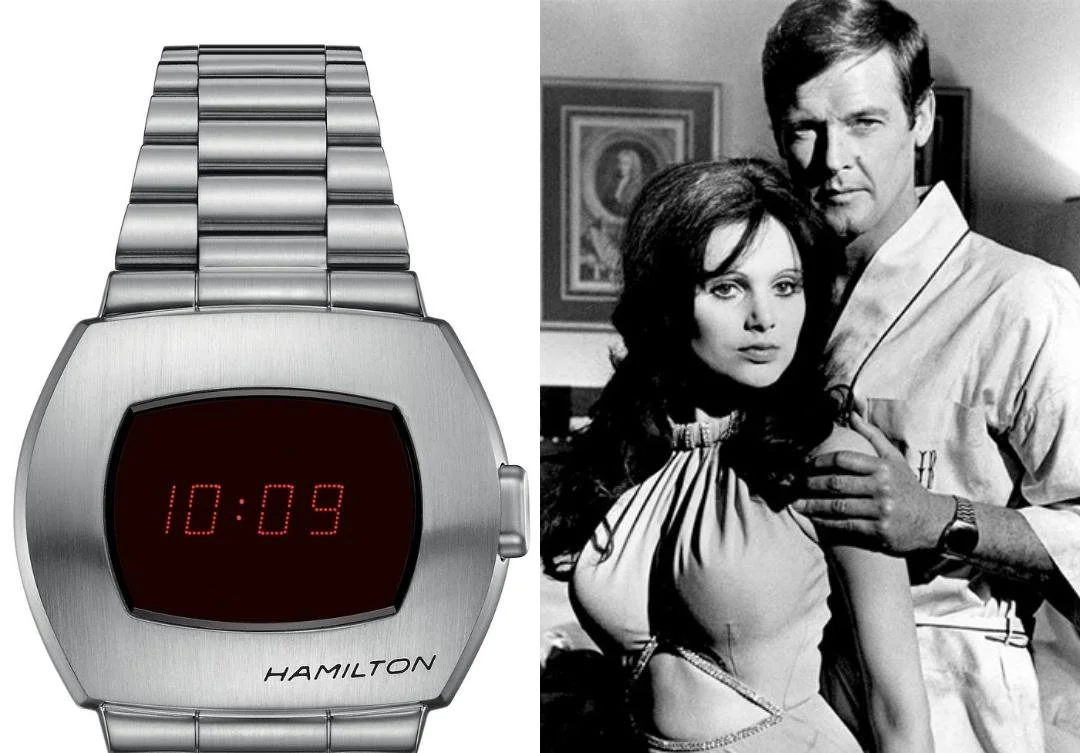
The watch that brought Bond into the electronic age
Let's begin with something that, by modern standards, looks rather like a very expensive calculator strapped to a bracelet.
The Hamilton Pulsar P2 made its appearance in Live and Let Die, Roger Moore's first outing as 007, and marked a significant departure from the traditional mechanical watches associated with Sean Connery.
Instead of hands sweeping across a dial, the Pulsar displayed the time through glowing red LED numerals.
In 1973, this was extraordinary.
Digital watches represented the future. They were expensive, technologically ambitious and sufficiently unusual to make their owners look as though they possessed classified information about the space programme.
Which, in Bond's case, probably wasn't far from the truth.
The Pulsar P2 featured an electronic movement housed in an unmistakably seventies stainless-steel case. Its display remained dark until activated, helping preserve precious battery life.
Today, that might sound inconvenient.
Back then, it was practically science fiction.
And herein lies its importance.
Roger Moore wasn't simply replacing Sean Connery. The franchise itself was evolving, embracing a more playful, technology-driven version of Bond.
The Pulsar communicated that transformation immediately.
It wasn't trying to be a Rolex. It wasn't attempting to replicate the established elegance of a mechanical dive watch.
It was making a statement.
The future had arrived, and apparently it came with red numbers.
As a piece of pure horology, the Pulsar lacks the mechanical romance of the watches further up our ranking. But as a cultural object, it represents one of the most significant technological turning points in Bond's wristwear history.
It deserves a place here because it helped establish something that would become fundamental to the franchise: Bond's watch could represent the future rather than merely reflect the present.
Our verdict: An important piece of electronic watchmaking history, even if it looks more at home aboard a seventies spacecraft than beneath a dinner jacket.
Explore the Hamilton PSR collection
9. Breitling Top Time
Thunderball (1965)
Bond: Sean Connery
Watch rating: 8/10
Bond significance: 6/10
Overall: 7/10
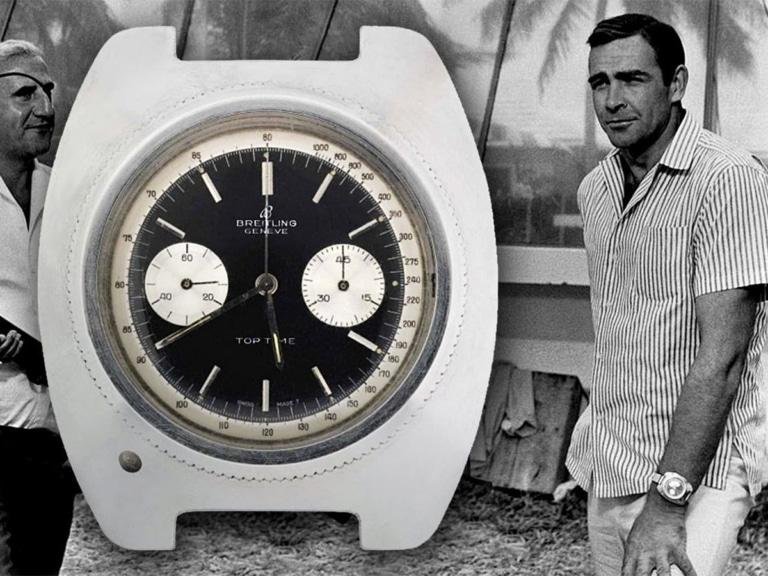
When a chronograph became a weapon against nuclear catastrophe
There are plenty of excellent reasons to own a chronograph.
Timing a race. Measuring a journey. Making your wrist look considerably more interesting than it did five minutes earlier.
Detecting stolen nuclear weapons, however, doesn't normally appear in the manufacturer's instruction manual.
Unless you're James Bond.
In Thunderball, Connery's Bond receives a modified Breitling Top Time equipped with a Geiger counter, enabling him to detect radiation as he investigates SPECTRE's stolen nuclear warheads.
This is where Bond's relationship with watches becomes something truly special.
The Breitling was no longer simply an elegant accessory. It was directly connected to the film's central threat.
Remove the watch, and you remove an important investigative tool.
The real Breitling Top Time was a handsome, manually wound chronograph, produced during a period when the brand was establishing itself as a serious name in sporting and professional timekeeping.
Its appeal came from its functional design, mechanical sophistication and confident styling.
It wasn't overly decorative.
It looked purposeful.
And that suited Connery's interpretation of Bond rather well.
Of course, the radiation-detecting modification belonged firmly to the world of cinema. Breitling wasn't quietly supplying secret agents with miniature nuclear detection laboratories.
At least, not that we're aware of.
What matters is the narrative role.
For the first time, a Bond watch could become an essential piece of equipment within the mission itself rather than a fashionable detail observed by particularly attentive viewers.
The Top Time demonstrated that an ordinary-looking watch could conceal something extraordinary.
A theme that would become increasingly important as Q Branch grew more ambitious.
Our verdict: A genuinely desirable vintage chronograph elevated by one of the earliest examples of Bond turning wristwear into operational equipment.
Explore Breitling's Top Time collection
8. Seiko G757 Sports 100
Octopussy (1983)
Bond: Roger Moore
Watch rating: 7/10
Bond significance: 7.5/10
Overall: 7.5/10
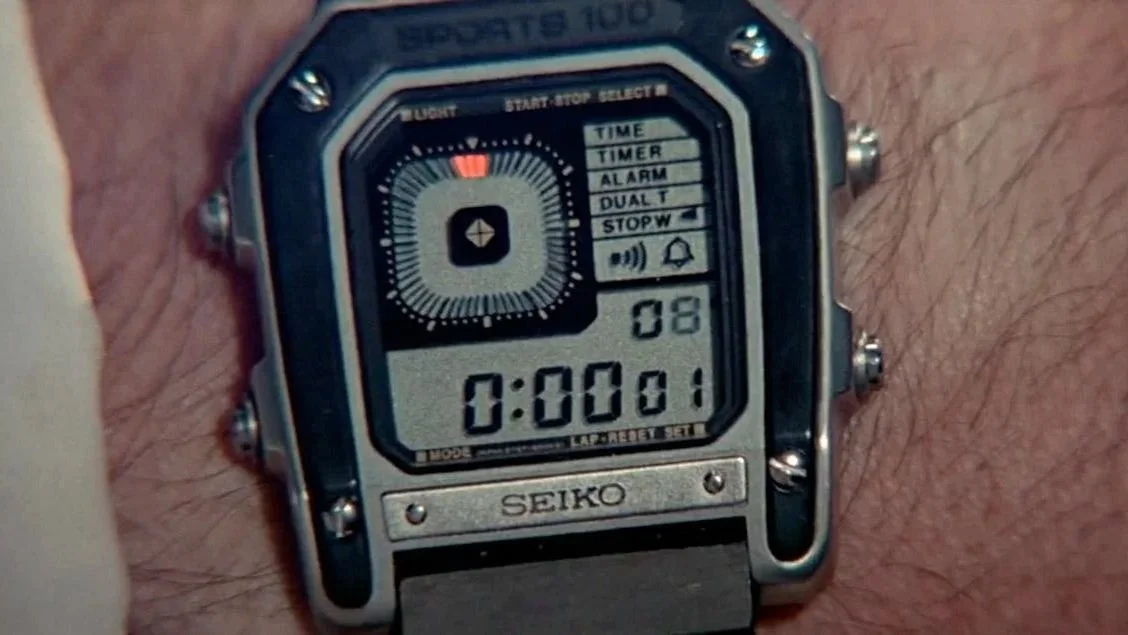
The decade when 007 started wearing tomorrow
There is something wonderfully unapologetic about Roger Moore's Bond.
The raised eyebrow. The increasingly elaborate escape sequences. The ability to deliver a one-liner while circumstances suggest everyone involved should probably be panicking.
And then there were the watches.
By the early eighties, Bond had embraced Seiko's digital technology with considerable enthusiasm.
In Octopussy, the Seiko G757-5020 Sports 100 becomes part of an elaborate tracking operation involving a Fabergé egg and an increasingly complicated international conspiracy.
Q Branch equips the watch to function as a receiver for a concealed tracking device.
Its display becomes a visual representation of Bond's pursuit.
The real watch was a quartz digital chronograph, featuring a distinctive rectangular display surrounded by a broad, horseshoe-like bezel.
It was practical, futuristic and completely different from the mechanical watches of the Connery years.
And while it might look rather ungainly beside a beautifully proportioned Rolex, dismissing it would be a mistake.
Seiko was doing genuinely innovative things with quartz technology.
The company had already transformed the industry through its pioneering electronic movements, and its digital watches brought advanced functionality to a much wider audience.
Bond's Seikos demonstrated that credibility didn't have to come exclusively from Swiss mechanical watchmaking.
A relatively attainable Japanese digital watch could possess technological sophistication that made an expensive mechanical timepiece appear almost quaint.
This mattered to the franchise.
Bond was no longer simply an impeccably dressed gentleman carrying expensive equipment.
He had become a walking demonstration of what the future might look like.
Admittedly, that future involved a lot of tiny buttons.
But the G757 earns its position because it represents a period when the films actively used watches to communicate technological possibility.
Our verdict: Not the prettiest Bond watch, but one of the most distinctive. A reminder that innovation sometimes looks better in retrospect than it did at the time.
Explore Seiko watches
7. Omega Seamaster Planet Ocean
Casino Royale (2006)
Bond: Daniel Craig
Watch rating: 9/10
Bond significance: 6/10
Overall: 7.5/10
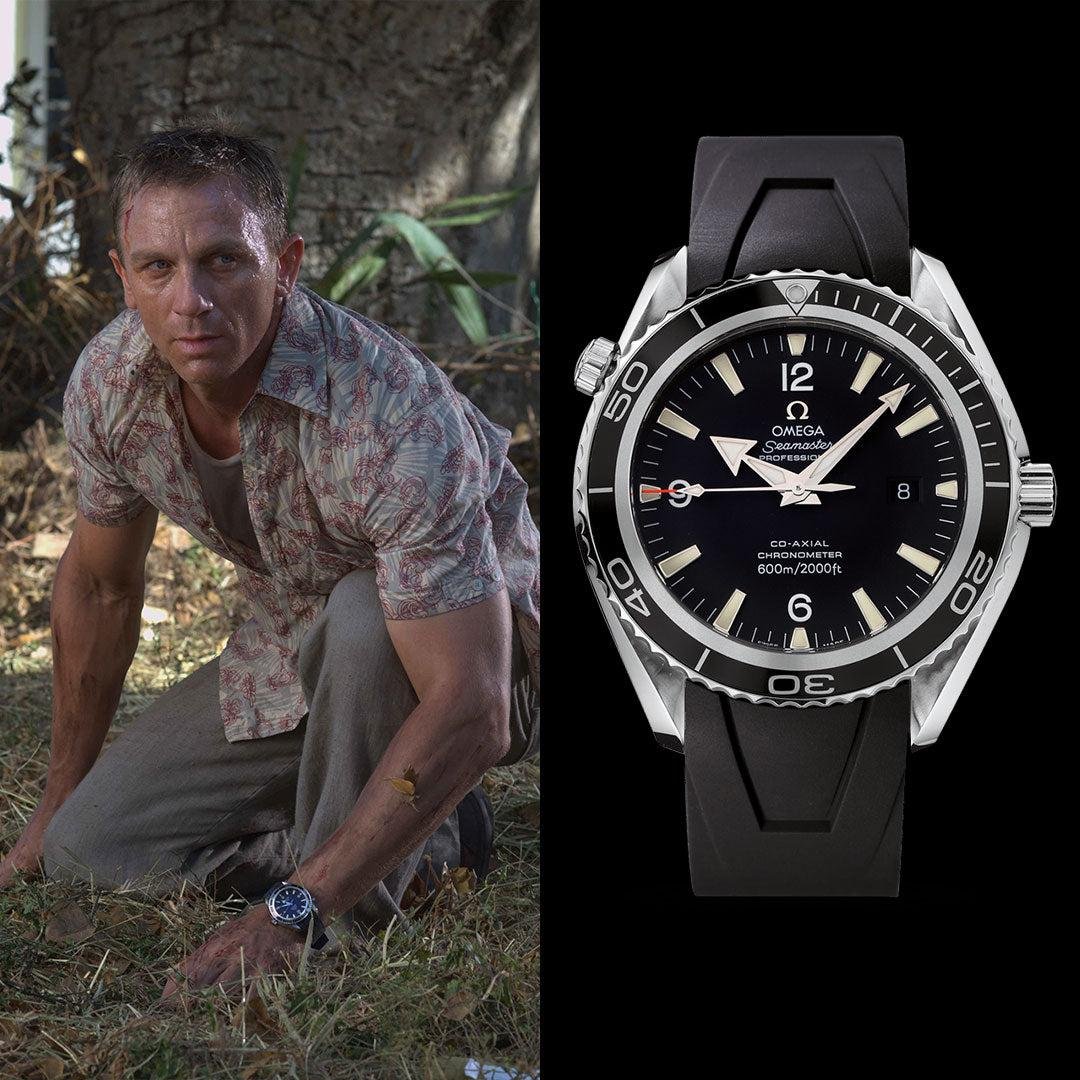
The watch that suited a different kind of Bond
When Daniel Craig first appeared as James Bond in Casino Royale, the franchise underwent a transformation.
Gone was much of the comfortable theatricality that had characterised earlier films.
In its place came physical vulnerability, emotional complexity and an interpretation of 007 who looked as though he might genuinely hurt himself jumping between buildings.
Craig's Bond was less polished.
More dangerous.
And considerably less concerned about keeping his dinner jacket in pristine condition.
The Omega Seamaster Planet Ocean fitted this character perfectly.
In Casino Royale, Bond wears a black-dial Planet Ocean on a rubber strap, alongside a blue-dial Seamaster Diver 300M elsewhere in the film.
The Planet Ocean was a substantial professional dive watch, featuring a 45.5mm stainless-steel case, 600 metres of water resistance and Omega's automatic Co-Axial chronometer movement.
This was serious equipment.
Not something chosen purely because it looked expensive beneath a tailored cuff.
Its robust construction, rotating dive bezel and excellent legibility reinforced the impression that Craig's Bond was a working operative first and a luxury lifestyle ambassador second.
The rubber strap was particularly important.
It suggested a man who might actually get wet.
Which, for a fictional character who spends a surprising amount of his working life falling into rivers, oceans and swimming pools, seems entirely sensible.
What makes the Planet Ocean special is its relationship with the character.
It doesn't need a laser, a detonator or a miniature telephone to justify its presence.
Its physical properties communicate Bond's personality.
Strong. Capable. Understated in purpose, if not quite in dimensions.
The Planet Ocean marked a return to the idea that Bond's watch should make sense as equipment.
A watch for someone who might actually need it.
Our verdict: One of the finest watches worn by 007 on purely technical grounds. It loses points only because other Bond watches have established a stronger cultural identity.
Explore the Omega Seamaster Planet Ocean
6. Seiko 0674-5009
The Spy Who Loved Me (1977)
Bond: Roger Moore
Watch rating: 6.5/10
Bond significance: 9/10
Overall: 7.5/10
The watch that practically invented the smartwatch fantasy
Imagine receiving a message on your wrist.
No phone required.
No need to retrieve a device from your pocket.
Just a discreet notification informing you that your employer urgently requires your attention.
Today, it's barely worth mentioning.
In 1977, it was fantastic cinema.
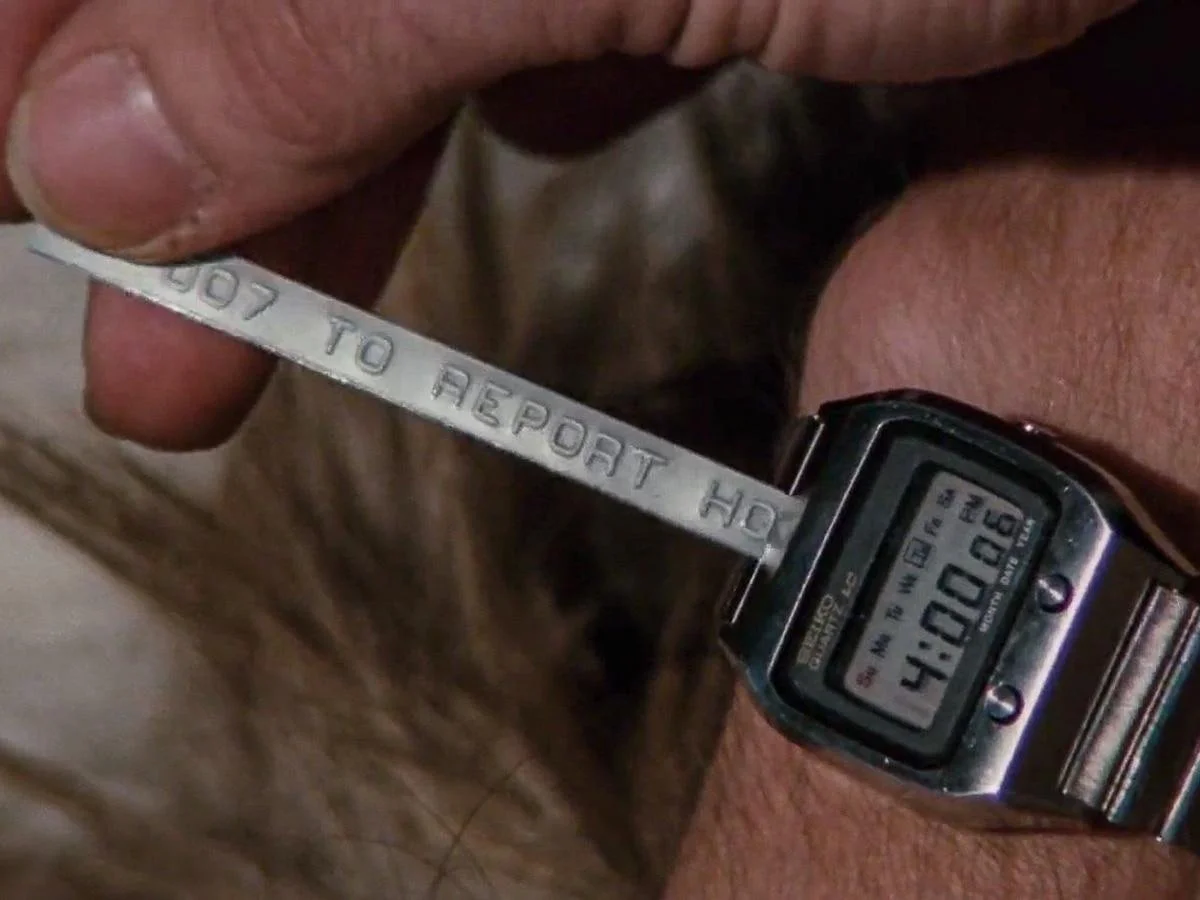
During The Spy Who Loved Me, Roger Moore's Bond receives instructions through his Seiko digital watch, with a narrow strip of printed tape emerging from the case.
It's one of the franchise's most memorable watch-related moments.
Not because the watch itself is especially beautiful.
Frankly, it isn't.
The rectangular case and digital display are very much products of their era.
But the scene captures something extraordinary: the idea that a wristwatch could become a personal communication device.
Decades before modern smartwatches offered messages, notifications and other distractions we sometimes wish we could escape, Bond was already being summoned back to the office through his wrist.
The real Seiko 0674-5009 was a quartz LCD watch.
The printing mechanism was a cinematic modification, not standard equipment available from your local jeweller.
Which is a shame, because we'd quite enjoy receiving restaurant reservations on a strip of miniature ticker tape.
The significance of this watch extends well beyond its technical specifications.
It established a visual language for the Bond gadget watch.
A familiar object could suddenly reveal an unexpected capability.
The audience didn't need an elaborate explanation. The watch performed its function, moved the story forward and made Bond appear effortlessly ahead of everyone else.
That's excellent storytelling.
And the beauty of it is that the watch remains entirely believable within its fictional world.
Unlike some later gadgets, the modification feels like a natural extension of the technology available at the time.
Our verdict: A modest watch elevated into Bond immortality by one brilliantly conceived scene. Proof that historical significance doesn't always arrive with an expensive movement.
Explore Seiko's heritage
5. Omega Seamaster 300 SPECTRE
Spectre (2015)
Bond: Daniel Craig
Watch rating: 9/10
Bond significance: 7/10
Overall: 8/10
When Omega finally embraced the Bond gadget properly
By the time Spectre arrived in cinemas, Omega had been associated with James Bond for two decades.
And although the partnership had produced some excellent watches, there was something particularly satisfying about the Seamaster 300 selected for this film.
It felt like a genuine meeting point between the classical Bond aesthetic and contemporary Swiss watchmaking.
The watch combined vintage-inspired styling with modern engineering.
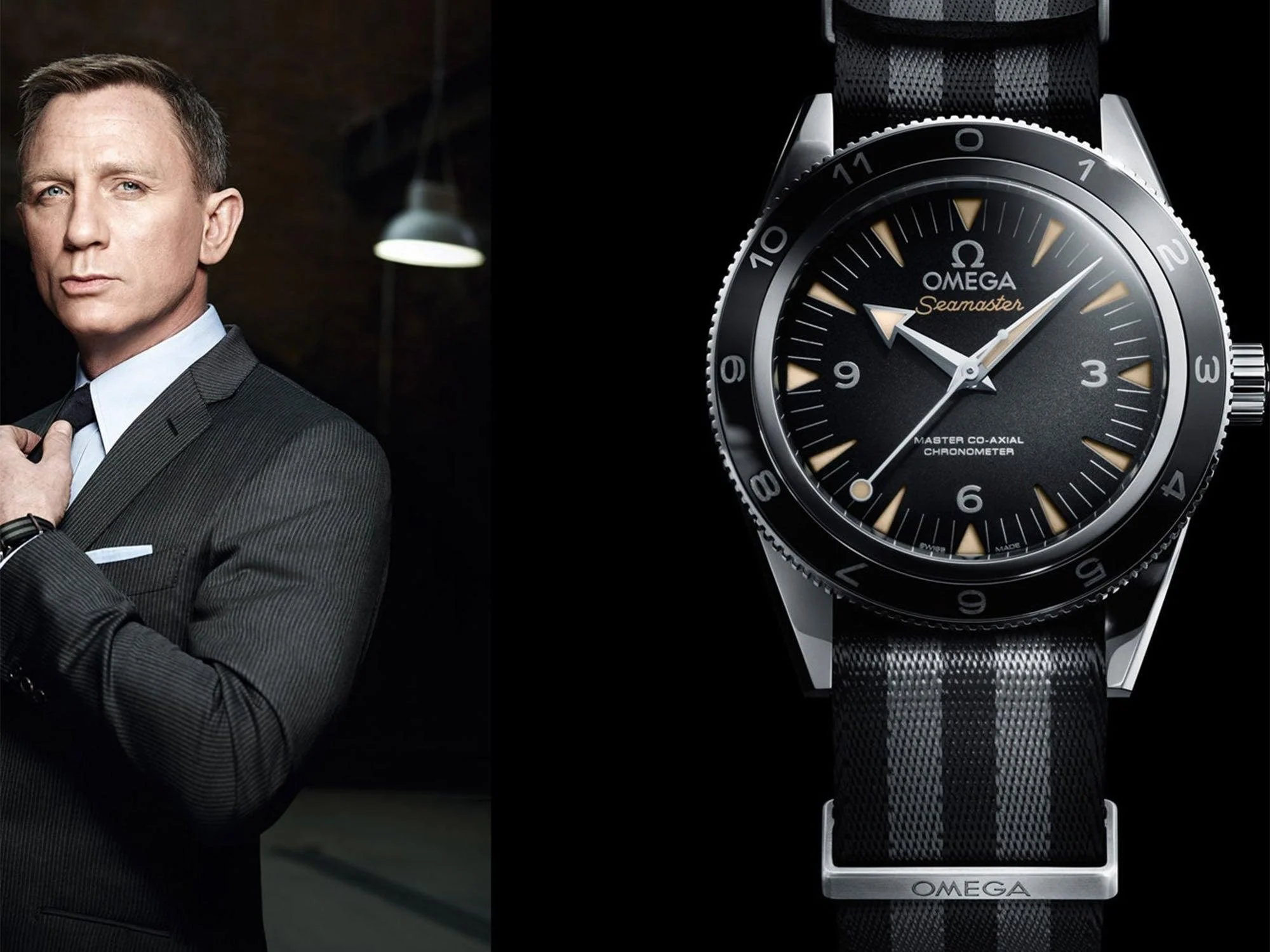
Its 41mm stainless-steel case housed a sophisticated automatic Co-Axial movement, while the black dial, broad-arrow hands and striped NATO strap created an appearance that felt simultaneously military, adventurous and unmistakably Bond.
There is an honesty to the design.
No unnecessary visual complications.
No desperate attempt to look futuristic.
Just a beautifully considered watch that could plausibly have existed in several different eras of the franchise.
And then Q got involved.
In Spectre, Bond's Seamaster conceals an explosive device, activated through the crown.
Suddenly, the watch is no longer merely an elegant companion.
It's an emergency escape plan.
One that would almost certainly void the manufacturer's warranty.
This is what makes the Spectre Seamaster such an interesting entry.
It combines the mechanical credibility of the modern Omega range with the gadget-driven storytelling of the Roger Moore years.
It's a watch enthusiasts can genuinely admire independently of its cinematic connection.
But it's also a watch that has a memorable reason to exist within the film.
Omega released a limited-edition version closely associated with the screen-worn design, allowing collectors to own something unusually faithful to Bond's equipment.
Minus the explosives, obviously.
The Spectre watch also demonstrated that Bond's wristwear could balance commercial desirability with narrative relevance.
Neither element needed to overwhelm the other.
Our verdict: One of the most complete modern Bond watches, combining mechanical substance, genuine design appeal and a wonderfully theatrical role in the plot.
Explore the Omega Seamaster collection
4. Omega Seamaster Diver 300M 007 Edition
No Time to Die (2021)
Bond: Daniel Craig
Watch rating: 9/10
Bond significance: 8/10
Overall: 8.5/10
The watch that said goodbye
Some watches become associated with memorable scenes.
Others become associated with particular actors.
And occasionally, one becomes inseparable from the end of an era.
The Omega Seamaster Diver 300M 007 Edition belongs firmly in that final category.
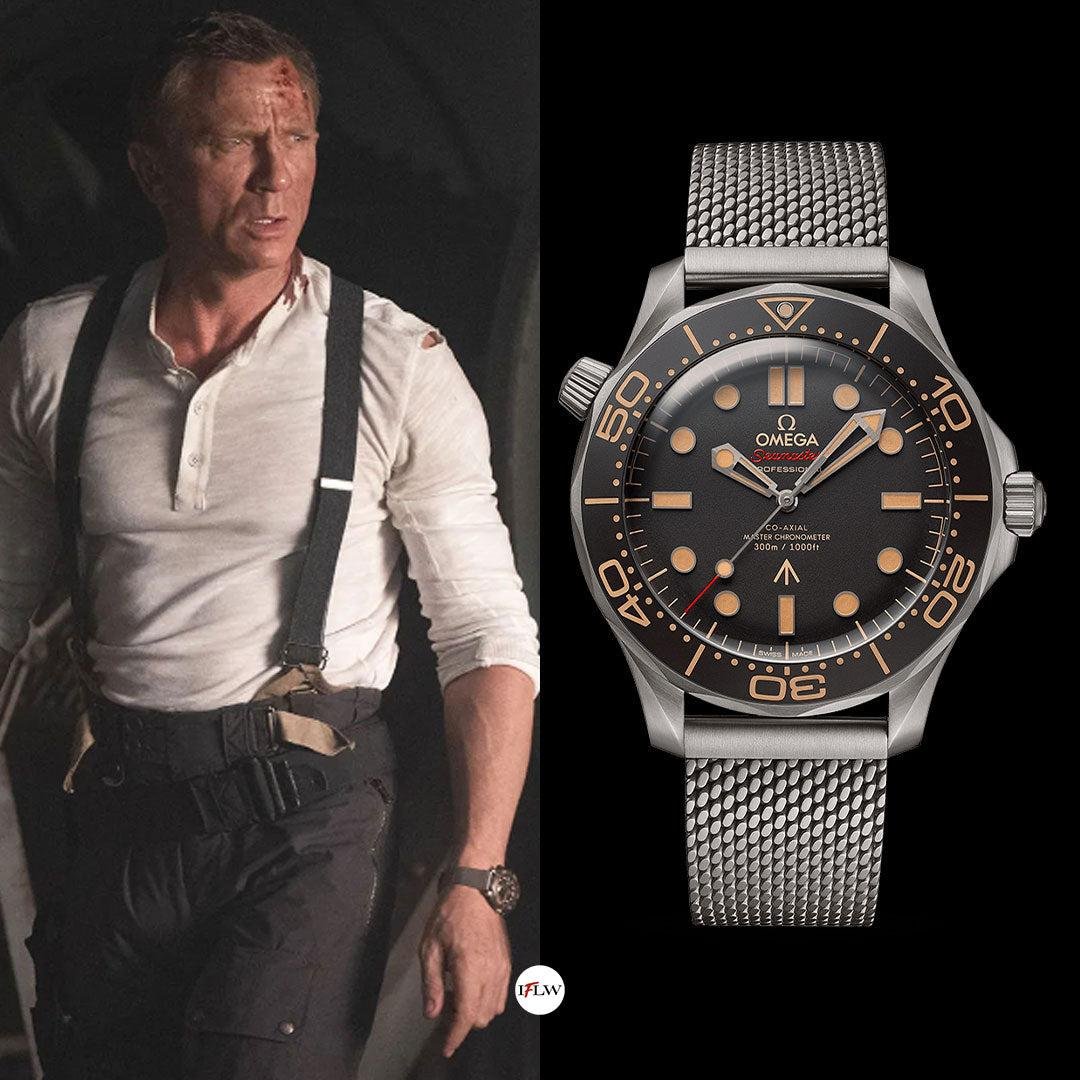
Worn by Daniel Craig in No Time to Die, the watch accompanied his fifth and final appearance as James Bond.
That alone gives it considerable significance.
But the watch itself deserves recognition.
Constructed from Grade 2 titanium, the 42mm case offers a lightweight alternative to traditional stainless steel.
Its brown aluminium bezel and dark dial are complemented by warm-toned luminous markers, creating a vintage-inspired aesthetic without abandoning modern performance.
Inside sits Omega's Master Chronometer-certified automatic movement, delivering strong resistance to magnetism alongside the precision and reliability expected from the brand.
A titanium mesh bracelet completes the military-inspired appearance.
And importantly, the design feels deliberate rather than decorative.
This isn't a watch trying to shout about its connection to a film.
It feels like an object selected for a particular character at a particular stage of his life.
Craig's Bond had changed enormously since Casino Royale.
The reckless, physically imposing new recruit had become an experienced operative carrying the weight of personal loss.
The Seamaster reflects that maturity.
It's practical, weathered in character and quietly confident.
There's also a satisfying sense of continuity.
After twenty-five years of Omega appearing on Bond's wrist, the partnership had become an established part of the franchise's identity.
This watch wasn't introducing anything.
It was completing something.
Of course, its presence in the film gains additional weight because of the story's conclusion.
We won't revisit every detail.
Suffice to say that Craig didn't exactly leave the door open for a straightforward sixth instalment.
The watch therefore becomes part of a cinematic farewell.
A final accessory for a Bond who had redefined the character.
Our verdict: One of Omega's most convincing Bond collaborations and a fitting conclusion to Daniel Craig's remarkable tenure.
Explore Omega's James Bond watches
3. Rolex Submariner 5513
Live and Let Die (1973)
Bond: Roger Moore
Watch rating: 9/10
Bond significance: 8.5/10
Overall: 8.5/10
The Rolex that proved a watch could steal the scene
If you want to understand why watches matter in James Bond films, consider what happens when an otherwise conventional Rolex Submariner is given a little attention by Q Branch.
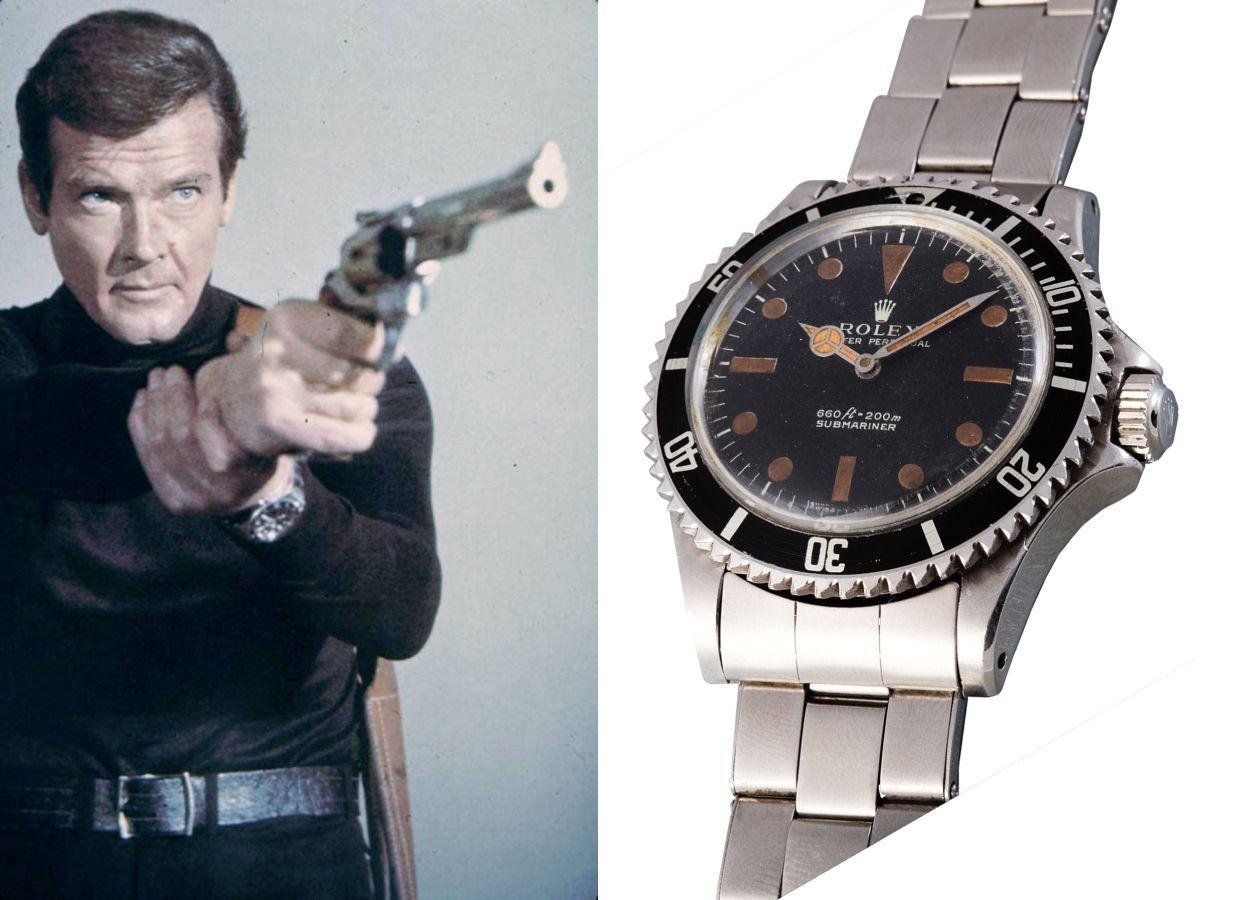
In Live and Let Die, Roger Moore wears a Rolex Submariner 5513 equipped with two distinctly unconventional functions.
The first is an extraordinarily powerful magnetic mechanism.
The second is a rotating bezel capable of functioning as a miniature saw.
Neither feature was available through Rolex's authorised dealer network.
Which, if we're being fair, seems a rather disappointing omission.
The genuine Submariner 5513 was already an exceptional watch.
Introduced during the early 1960s, it became one of the defining references in the Submariner's history.
Its clean, no-date dial, rotating timing bezel, robust Oyster case and dependable automatic movement established the fundamental visual language of the professional dive watch.
The appeal wasn't complicated.
The 5513 looked right.
Perfectly balanced, immensely legible and designed with a sense of purpose that few luxury watches have matched.
Even without Bond, it would be a highly desirable vintage Rolex.
But Live and Let Die transformed it into something more.
The magnetic function and buzz-saw bezel are directly involved in the film's action.
The watch isn't just being worn by Bond.
It's helping him survive.
And unlike some of the more fantastical gadgets of the franchise, the Rolex itself remains instantly recognisable beneath the modifications.
This creates a wonderful tension.
On one hand, the Submariner represents the very best of practical mechanical watchmaking.
On the other, the film turns it into an almost absurdly versatile instrument.
That combination is quintessentially Bond.
The 5513 is significant because it brings together two major elements of the franchise's watch history: the rugged sophistication established by Connery and the increasingly inventive gadgets associated with Moore.
One watch, two very different interpretations of 007.
And somehow it works.
Our verdict: A near-perfect professional dive watch made unforgettable by one of Q Branch's most entertaining modifications.
Explore Rolex's Submariner collection
2. Omega Seamaster Professional 300M
GoldenEye (1995)
Bond: Pierce Brosnan
Watch rating: 8.5/10
Bond significance: 9.5/10
Overall: 9/10
The watch that changed James Bond forever
For an entire generation, James Bond doesn't wear a Rolex.
He wears an Omega.
And much of that association began with Pierce Brosnan's GoldenEye.
When Brosnan took over the role in 1995, the franchise faced a considerable challenge.
Bond needed to remain recognisable without appearing trapped in another decade.
The Cold War had ended.
Audience expectations had changed.
And the character needed to re-establish himself as a relevant modern action hero.
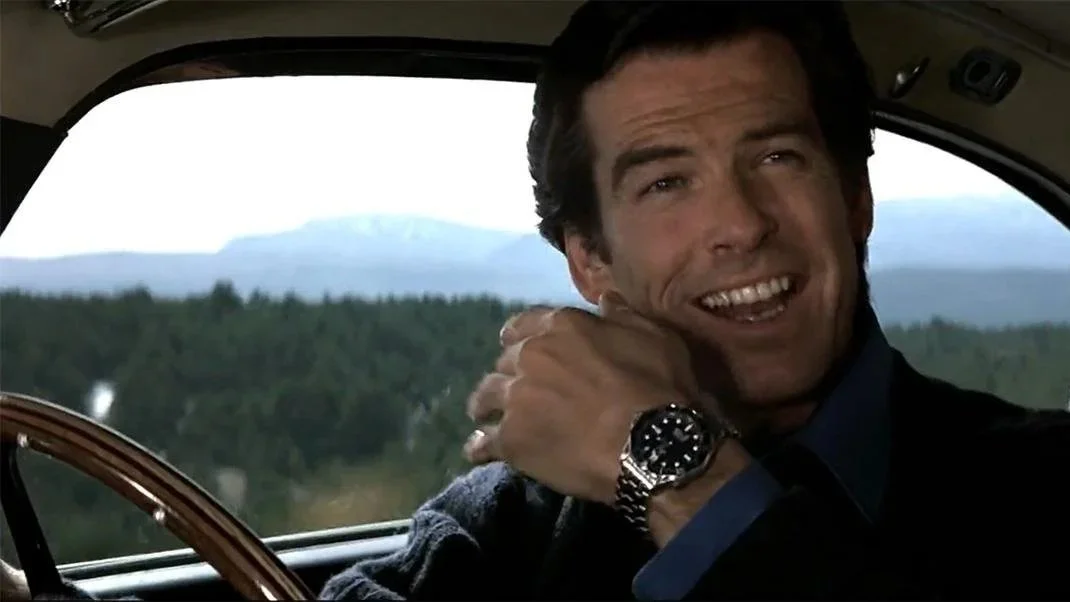
Enter the Omega Seamaster Professional 300M, reference 2541.80.
Its blue wave-pattern dial, distinctive skeletonised hands and unmistakable scalloped bezel created an entirely new visual identity for Bond's wrist.
The watch featured a stainless-steel case, 300 metres of water resistance and a quartz movement.
Yes, quartz.
A detail that occasionally causes mechanical-watch enthusiasts to behave as though someone has served warm champagne at a black-tie dinner.
But here's the thing.
The decision worked.
The Seamaster looked sophisticated, practical and contemporary.
It was recognisably a professional dive watch, yet refined enough to accompany Brosnan's impeccably tailored suits.
And crucially, it was integrated into the action.
In GoldenEye, the watch is equipped with a laser cutter and remote detonator, demonstrating once again that Q Branch considered accurate timekeeping merely the beginning of its responsibilities.
The laser became one of the defining gadgets of Brosnan's debut.
But the real importance of the Seamaster lies beyond the film itself.
This was the beginning of Omega's continuing association with James Bond.
A relationship that would survive multiple films, a complete character reboot and the transition from Brosnan to Craig.
Few watches can claim to have altered the visual identity of a major cinematic franchise quite so completely.
And here's an interesting thought.
For viewers who grew up watching Brosnan, the blue Seamaster is arguably more immediately recognisable as a Bond watch than the original Rolex Submariner.
That isn't necessarily a judgement on watchmaking quality.
It's a reflection of cultural association.
Bond wore the Omega.
Therefore, the Omega became Bond.
It's difficult to imagine a more successful example of a watch becoming part of a fictional character's identity.
Our verdict: Not the finest mechanical watch on this list, but arguably the most transformative. The blue Seamaster reshaped the relationship between James Bond and modern luxury watchmaking.
Explore the Omega Seamaster Diver 300M
1. Rolex Submariner 6538
Dr. No, From Russia with Love, and Goldfinger
Bond: Sean Connery
Watch rating: 10/10
Bond significance: 10/10
Overall: 10/10
The watch that started everything
There was never really going to be another winner, was there?
The Rolex Submariner 6538 is more than a watch associated with James Bond.
It's one of the foundations upon which the character's visual identity was built.
When Sean Connery first appeared as 007 in Dr. No in 1962, the world was introduced to a particular interpretation of masculine sophistication.
Elegant, certainly.
But also physical, capable and entirely comfortable with danger.
Connery's Bond could move effortlessly between a casino, a luxury hotel and a life-threatening confrontation without appearing to change his fundamental personality.
He was equally convincing in a dinner jacket or a polo shirt.
And the watch on his wrist needed to communicate the same versatility.
The Submariner 6538 did exactly that.
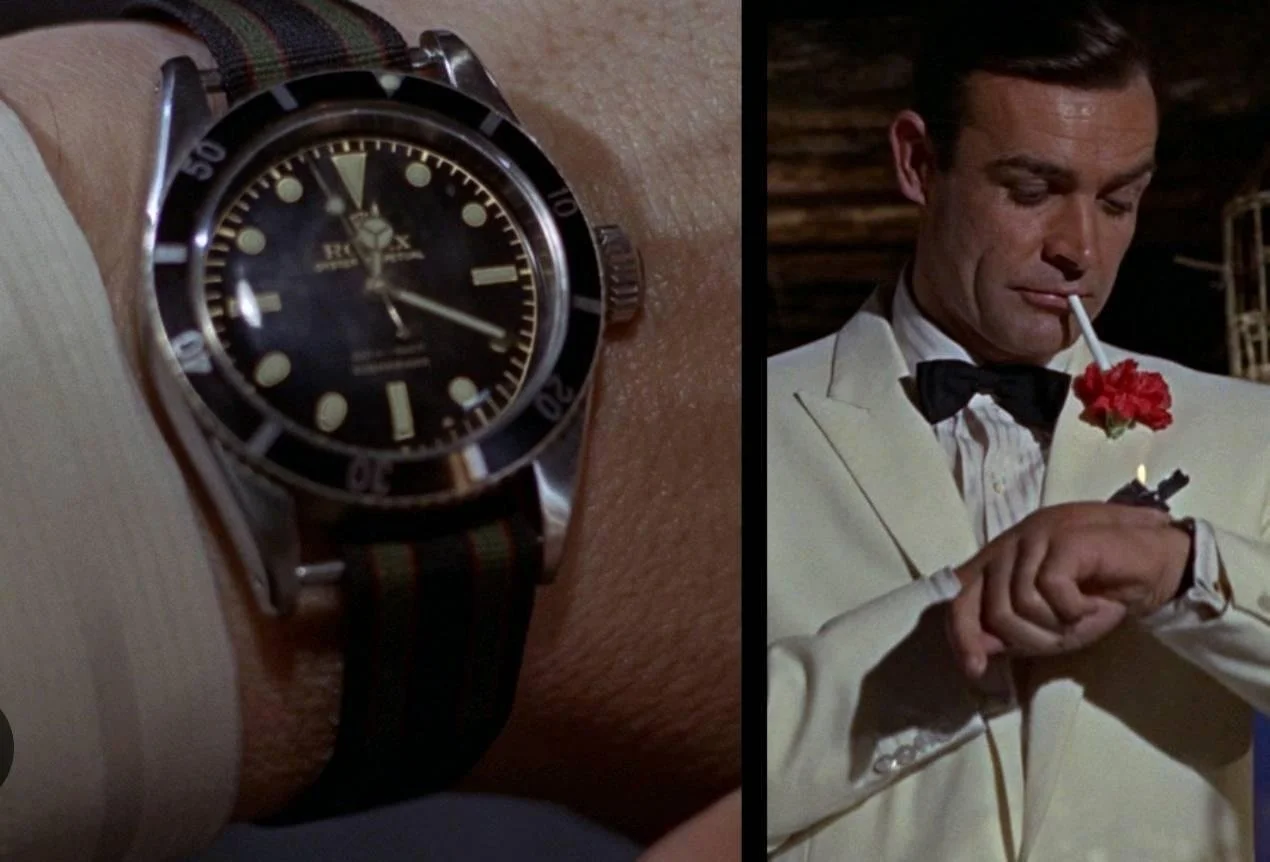
Known to collectors as the Big Crown Submariner, the reference featured an oversized winding crown, no protective crown guards and a wonderfully balanced dial.
Its design was practical rather than decorative.
A rotating bezel for timing dives.
Bold luminous hour markers.
A robust automatic movement.
And a steel case intended to withstand difficult conditions.
It was everything a professional tool watch should be.
But placed on Connery's wrist, it became something else.
An object of enduring cinematic style.
The watch is particularly memorable in Goldfinger, where it appears on a striped fabric strap during the film's famous opening sequence.
It's one of those small details that has achieved almost disproportionate significance among watch collectors.
The strap isn't especially elegant.
By contemporary luxury-watch standards, the whole arrangement is almost casual.
And that's exactly why it works.
Bond isn't trying to impress anyone with his watch.
He's wearing something suitable for the job.
The confidence comes from the character, not the price tag.
That distinction is important.
Modern luxury marketing often attempts to convince us that an expensive watch will somehow transform the personality of its owner.
Connery's Bond demonstrated the opposite.
The character made the watch desirable.
And more than sixty years later, that association remains remarkably powerful.
The Submariner 6538 wasn't selected because it offered the most advanced gadgetry.
It didn't communicate messages, track stolen objects or fire lasers.
It simply performed its original function exceptionally well.
Its presence helped establish an enduring rule for Bond's wardrobe.
Everything should look as though it belongs there.
Nothing should feel unnecessarily decorative.
And even the most expensive object should appear to have been chosen for a practical reason.
That philosophy extends beyond watches.
It's present in Bond's tailoring, cars and equipment.
But nowhere is it expressed more neatly than through the original Submariner.
For collectors, the 6538 has become one of the most desirable vintage Rolex references, with its Bond connection contributing to an already formidable reputation.
And although later watches introduced more sophisticated technology, more imaginative gadgets and greater technical performance, none has truly displaced the original.
The Omega Seamaster might define the modern Bond.
The Seiko digital watches might capture the franchise's most inventive period.
But the Rolex Submariner 6538 represents the beginning of the relationship between James Bond and serious watchmaking.
Everything that followed owes something to it.
Our verdict: The definitive James Bond watch. An extraordinary design, an unmistakable cinematic association and the clearest expression of what makes Bond's personal style so enduring.
Explore the Rolex Submariner collection
What Should Robert Pattinson Wear as James Bond?
And here's where things get particularly interesting for watch enthusiasts, with Robert Pattinson being named the seventh James Bond, ushering in a new era for 007 under Amazon MGM Studios, with Denis Villeneuve directing and Steven Knight developing the screenplay.
But there's a rather intriguing complication. One that has considerably more to do with Swiss watchmaking than international espionage.
Just two months before the reported casting announcement, Pattinson became a global ambassador for Jaeger-LeCoultre, appearing in a campaign featuring the exquisite Master Control Chronomètre Perpetual Calendar.
Now, normally, an actor signing a watch endorsement deal wouldn't raise too many eyebrows. But when that actor is reportedly about to inherit the world's most famous licence to kill, things become considerably more interesting.
Because James Bond already has a watchmaker.
And it's a rather important relationship.
Omega has accompanied 007 since Pierce Brosnan first strapped on a Seamaster in GoldenEye back in 1995. Through exploding pens, invisible cars, collapsing buildings and Daniel Craig's considerably more bruising interpretation of the character, the Seamaster has remained a reassuring constant.
So, what happens when the new Bond arrives with an existing relationship with another prestigious Swiss manufacturer?
Does Omega retain its place beneath that famous dinner jacket? Could Jaeger-LeCoultre become the latest.
Winding Things Up
There's a reason we're still talking about a Rolex Submariner that appeared on Sean Connery's wrist more than sixty years ago.
And it isn't simply because watch collectors have developed an extraordinary ability to argue about reference numbers, crown guards and whether a particular bezel insert is worth more than the average family car.
It's because James Bond has always been about more than the films themselves.
He's a reflection of his time. A constantly evolving combination of style, sophistication, technology and, occasionally, some truly questionable decision-making.
Each actor has brought something different to the role.
Connery gave us the original blueprint: effortlessly cool, impeccably dressed and entirely comfortable ordering a martini while wearing a watch designed for underwater exploration.
Moore introduced humour, charm and an impressive collection of gadgets that would probably require their own insurance policy today.
Dalton brought a sharper, more serious edge.
Brosnan combined old-fashioned elegance with the technology-driven optimism of the 1990s.
And Craig stripped away much of the polish, giving us a Bond who was bruised, vulnerable and considerably more likely to emerge from a fight needing medical attention.
Through it all, the wristwatch has remained a remarkably consistent part of the character.
Sometimes it's a life-saving gadget. Sometimes it's a showcase for the latest technology. Sometimes it's a subtle expression of wealth, taste or personality.
And sometimes it's simply a very good watch.
But the important thing is that it belongs.
Which brings us neatly to Robert Pattinson and the intriguing question of what happens next.
With his reported appointment, a new creative direction under Denis Villeneuve and an existing ambassadorial relationship with Jaeger-LeCoultre, there's every possibility that Bond's next chapter could look rather different.
Whether that means saying goodbye to Omega remains to be seen.
And while we'd be sorry to see the Seamaster disappear, perhaps that's part of the excitement. Bond has never stood still, and neither has the watch industry.
What matters is that the next watch feels authentic to the character, rather than simply being the result of whichever manufacturer has the largest marketing budget.
Because the right watch can do something rather extraordinary.
It can become inseparable from the actor wearing it.
It can influence generations of collectors, define an era and remain culturally significant long after the film itself has disappeared from cinema screens.
Which is precisely why the Rolex Submariner Reference 6538 takes our number-one position.
Not because it's the most technically sophisticated watch in this countdown.
Not because it's the most expensive.
And certainly not because it can fire a laser, detonate an explosive charge or somehow persuade a villain to explain their entire plan before attempting to kill its owner.
It wins because it helped establish the relationship
Image credits and copyright: James Bond film stills and promotional imagery remain the property of their respective copyright holders, including EON Productions, Danjaq and Amazon MGM Studios, as applicable. Images are reproduced for editorial commentary, criticism and historical discussion, with individual credits provided wherever possible.