
Singer Reimagined 1970 DualTrack: GMTs Just Got A Serious Seventies Makeover
Singer Reimagined has never been particularly interested in making watches that quietly blend into the background. The brand’s latest creation, the 1970 DualTrack, is certainly no exception.
Taking Singer’s rather unconventional approach to watchmaking and throwing it into the angular world of 1970s design, the DualTrack is a completely new take on the dual time watch. It is bold, architectural and, rather refreshingly, tries to make a GMT complication actually easier to live with.
And yes, it looks rather good while doing it.
A Very Seventies Singer
The clue is very much in the name. The 1970 DualTrack takes its design inspiration from the early 1970s, an era when watch designers seemingly decided that round cases had become terribly boring.
Sharp edges, faceted surfaces and integrated bracelets were suddenly everywhere, and Singer has taken those ideas and given them its own modern interpretation.
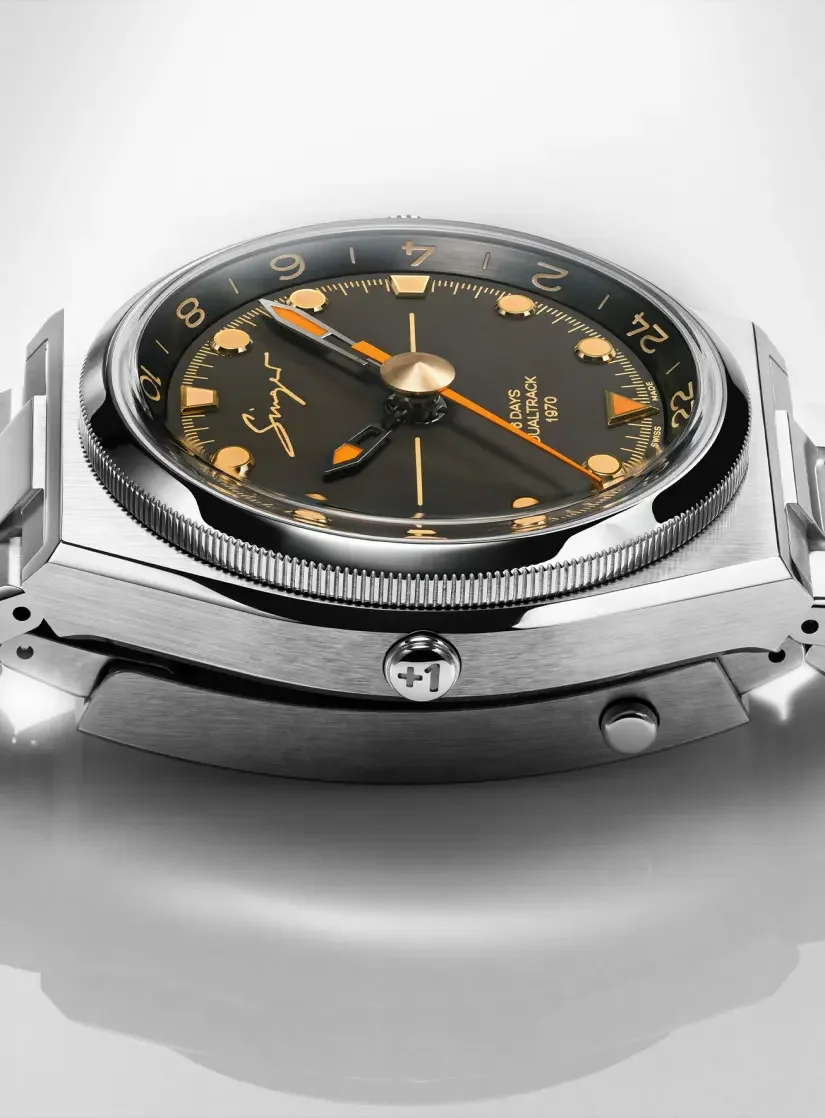
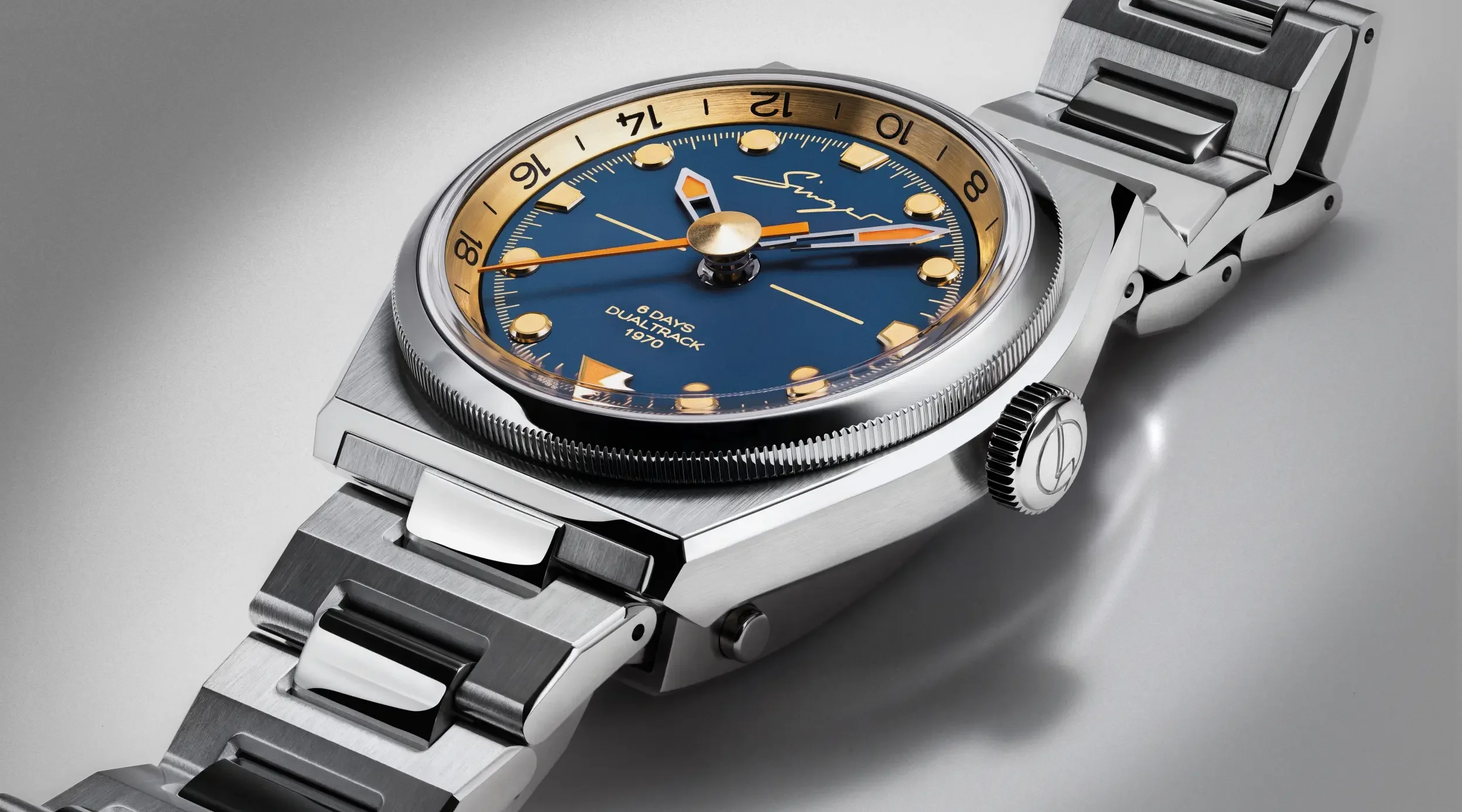
The result is a 40mm stainless steel case measuring 12.6mm thick, with a combination of brushed surfaces and mirror polished chamfers. It has the sort of sculptural presence that makes a conventional sports watch look positively conservative.
The integrated stainless steel bracelet continues the theme, using alternating brushed and polished links to create a layered appearance that should catch the light rather nicely.
It is unmistakably 1970s inspired, but this is not a simple exercise in vintage nostalgia. Singer has taken the visual language of the decade and given it a contemporary twist.


Two Time Zones, Without The Usual Fuss
The clever bit is what Singer has done with the GMT function.
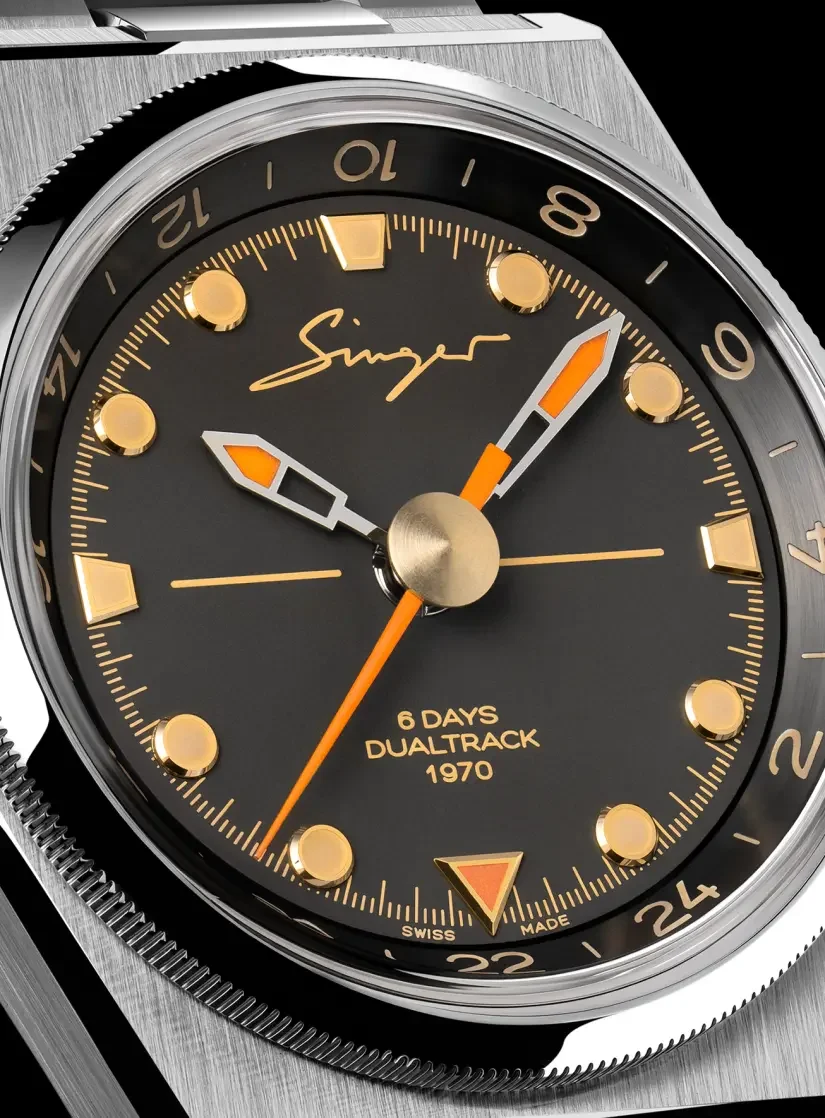
Rather than adding another conventional hand to the dial and making you play a small game of horological Where’s Wally every time you want to check the time somewhere else, the DualTrack uses a rotating 24 hour flange positioned around the inner edge of the dial.
Your local time remains front and centre, displayed using conventional hour and minute hands.
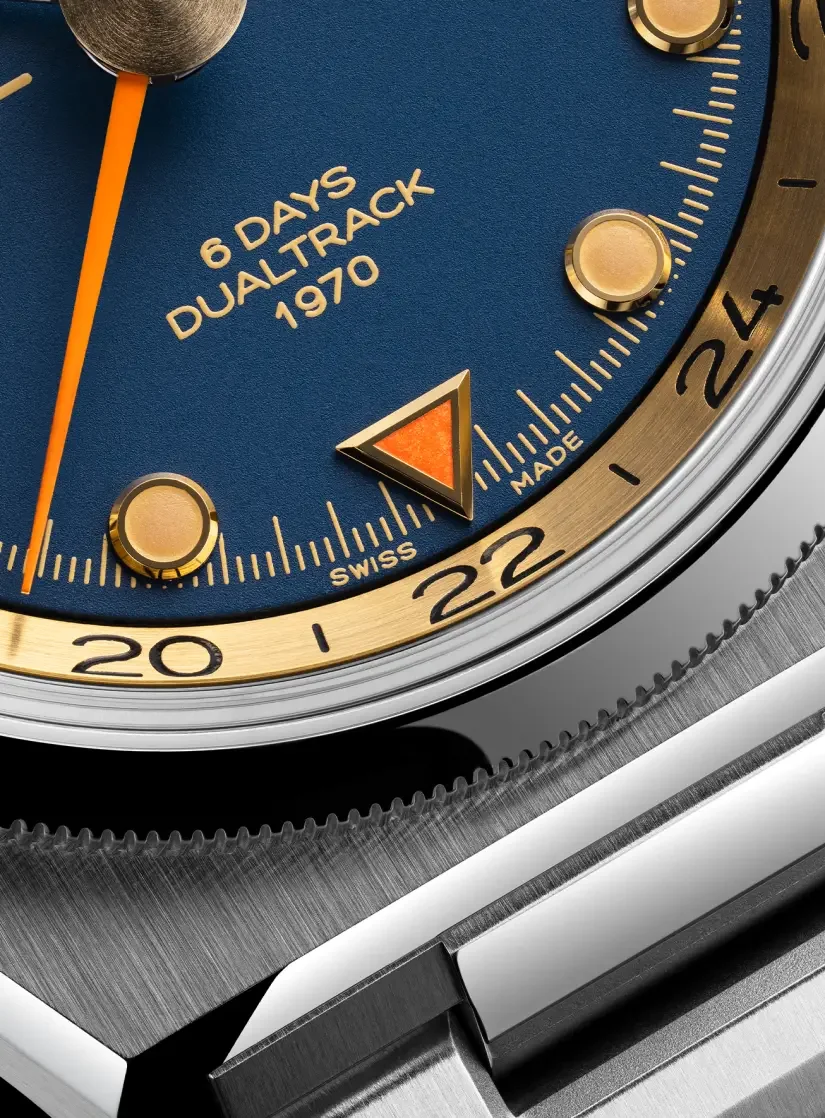
The second time zone is displayed on the rotating 24 hour disc and is read against a fixed marker at 6 o’clock.
It is a wonderfully simple idea. Instead of trying to differentiate between two hour hands travelling around the same dial, Singer essentially separates the two time zones visually.
Even better, the second time zone is adjusted using a pusher at 9 o’clock, which advances the 24 hour disc in one hour increments.
For anyone who regularly jumps between time zones, it makes considerably more sense than some of the more complicated GMT solutions currently doing the rounds.
A Movement Worth Looking At
Underneath all that 1970s inspired styling sits Singer’s Calibre 4 DT Slim, also known as the ST5001.
It is a manually wound proprietary movement measuring just 6.66mm thick and contains 197 components and 39 jewels.
More importantly, it uses four flat mounted barrels and provides a rather impressive 144 hour power reserve.
That works out at six days, meaning you can take the watch off on Monday, forget about it until the weekend and still have a fighting chance of finding it running.
The movement operates at 28,800 vibrations per hour and has been engineered specifically to fit within the relatively slim 12.6mm case.
And because this is Singer Reimagined, the movement is not simply there to do a job. It is very much part of the overall engineering story behind the watch.
Three Very Different Flavours
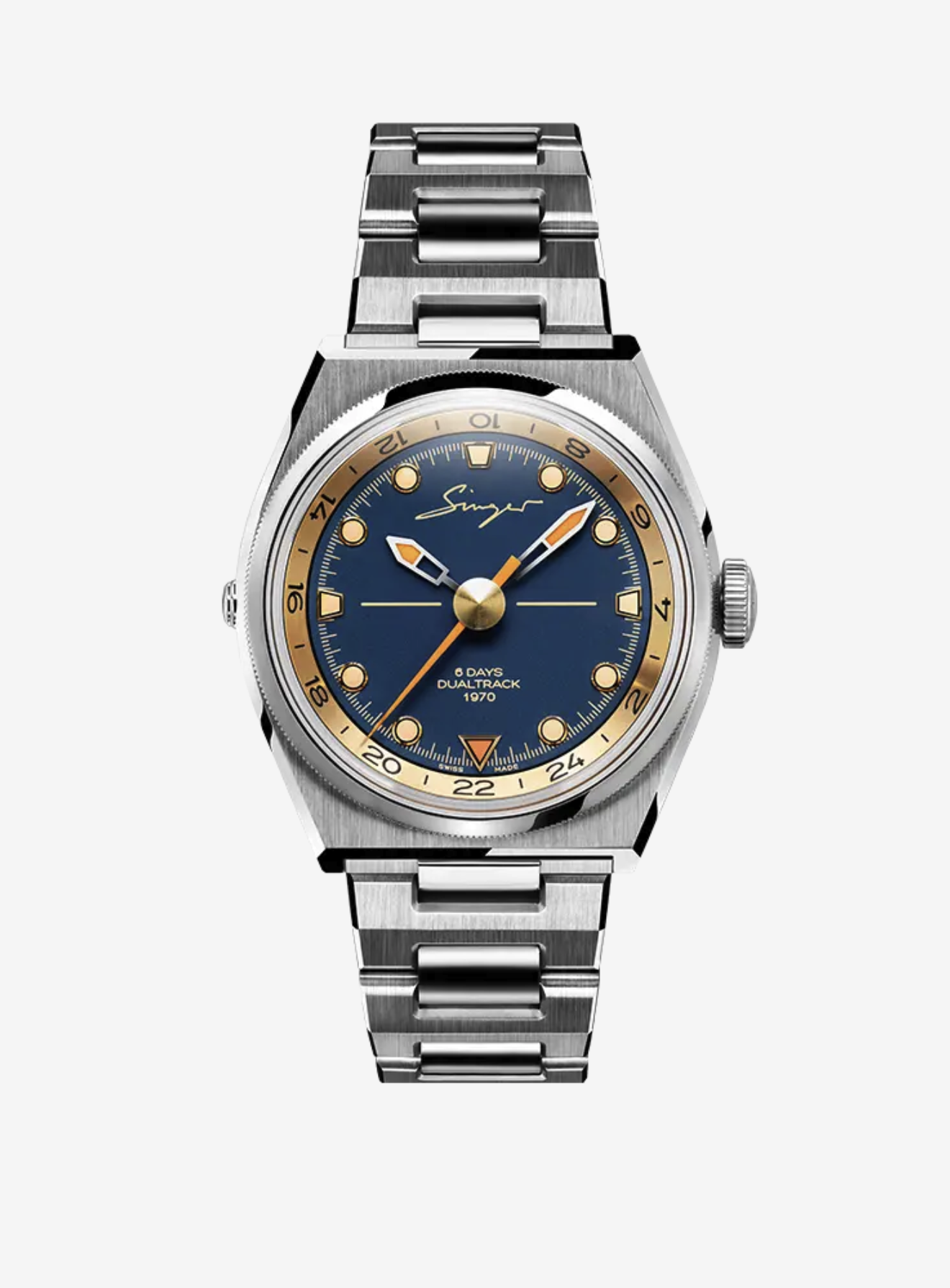
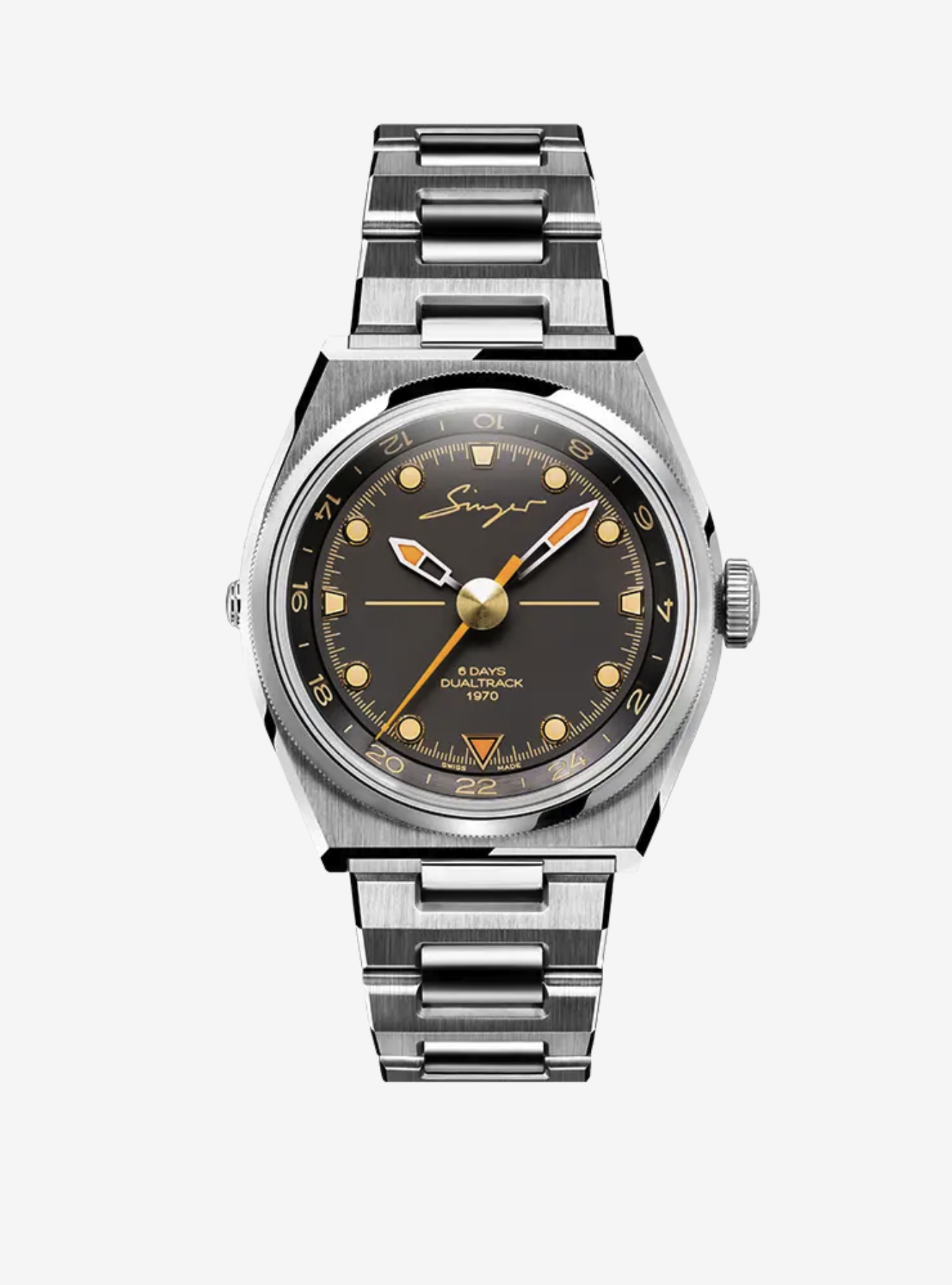
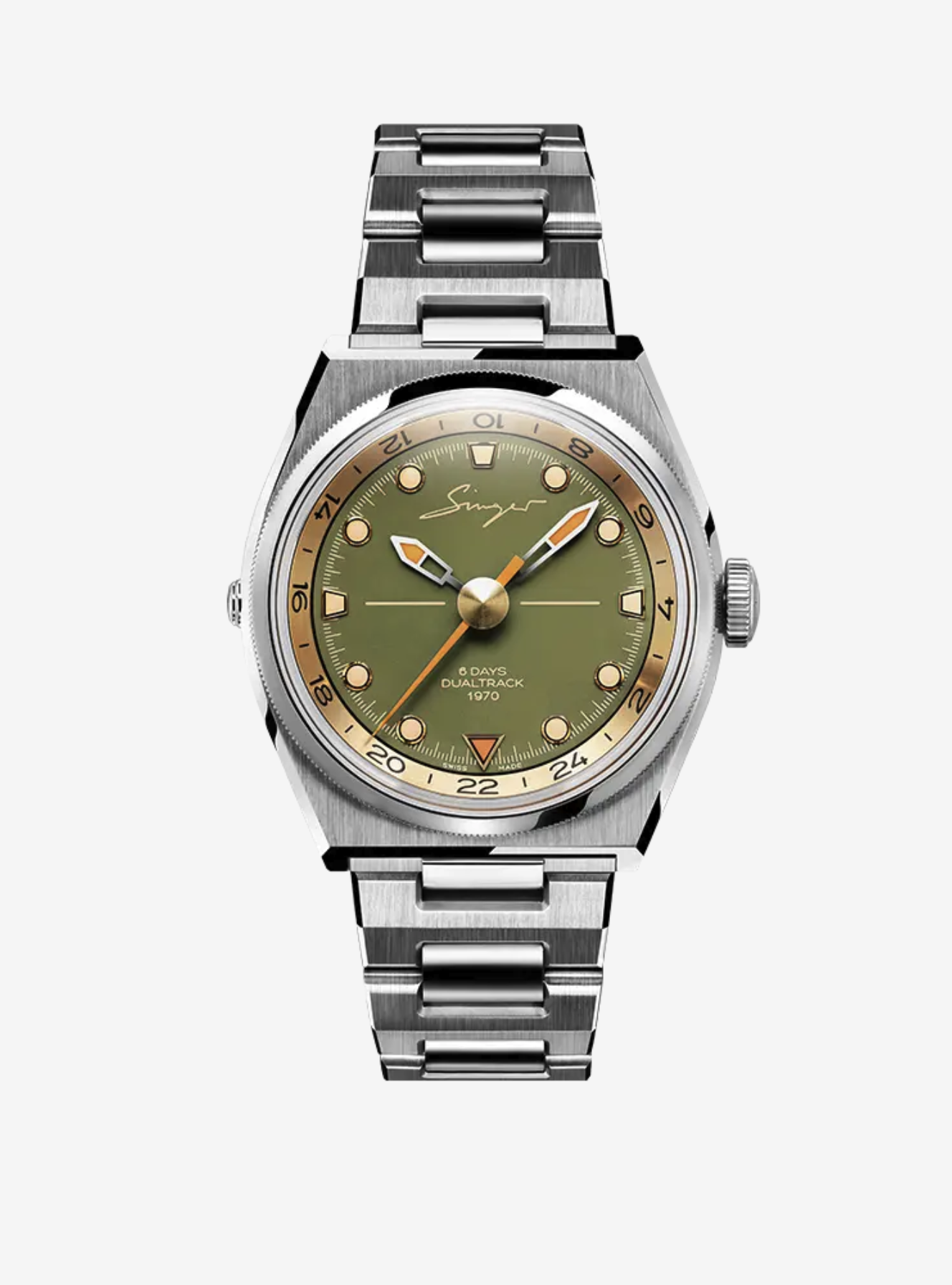
Singer is launching the 1970 DualTrack in three dial configurations.
There is Velvet Khaki Green, Velvet Cobalt Blue and Velvet Dark Espresso Brown.
The colours suit the design beautifully, particularly when combined with the gold accents, faceted hour markers and contrasting Super LumiNova.
The Cobalt Blue version is arguably the most attention grabbing, while the Khaki has a slightly more utilitarian feel. The Espresso Brown, meanwhile, feels like Singer has discovered a very expensive 1970s sports car and decided to turn its dashboard into a watch.
All three use Singer’s distinctive combination of cream and orange luminous details, with openworked hour and minute hands and an orange central seconds hand.
A Proper Travel Watch
What makes the DualTrack particularly interesting is that Singer has not simply taken an existing watch and bolted a GMT function onto it.
The entire watch has been designed around the idea of tracking two times simultaneously.
Singer describes it as a watch for people who live across different places, schedules and time zones, and that thinking is evident in the layout.
It is a subtle distinction, but an important one. The second time zone isn't treated as an additional complication. It is central to the way the watch works.
That makes the DualTrack feel considerably more purposeful than many GMT watches that essentially use a fourth hand because, well, GMT watches are supposed to have fourth hands.
The Numbers
The 1970 DualTrack measures 40mm across and 12.6mm thick, with a stainless steel case and integrated stainless steel bracelet.
The domed sapphire crystal receives anti reflective coating on both sides, while the sapphire crystal caseback gives you a view of the Calibre 4 DT Slim.
Water resistance is rated at 100 metres, making this considerably more practical than the precious looking design might initially suggest.
The movement operates at 4Hz and offers 144 hours of power reserve, while the bracelet incorporates a quick adjustment system within the folding clasp.
References are SR811 2 for Khaki, SR811 3 for Cobalt Blue and SR811 5 for Dark Espresso Brown.
And Then There Is The Price
This is where things get rather Singer.
The 1970 DualTrack is priced at CHF 23,500 before VAT, putting it firmly into serious independent watch territory.
That is not pocket change, obviously, but Singer Reimagined has never been aiming for the mass market. This is a highly engineered independent watch with a proprietary movement, an unusual approach to displaying a second time zone and a design that you are extremely unlikely to confuse with anything else on the wrist.
The watch is due to become available through Singer Reimagined retailers from October 2026 and will form part of the permanent collection.
Winding Things Up
The Singer Reimagined 1970 DualTrack is exactly the sort of watch we like seeing from independent brands.
It takes a familiar complication, asks whether there is a better way of doing it and then builds an entire watch around the answer.
The 1970s inspired styling will obviously divide opinion, but that is rather the point. Singer has never been in the business of making watches for people who want something anonymous.
The clever GMT display is arguably the star of the show, though. By keeping local time central and moving the second time zone onto its own rotating 24 hour track, Singer has created something that looks complicated without actually being complicated to use.
Add in six days of power reserve, a beautifully engineered movement and that wonderfully angular integrated bracelet and the DualTrack becomes a very compelling piece of independent watchmaking.
It is expensive, distinctive and completely unnecessary.
In other words, it is exactly the sort of watch Singer Reimagined should be making.
