
A. Lange & Söhne Triple Split: The Chronograph That Makes Other Chronographs Look A Bit Basic
There are chronographs, there are complicated chronographs and then there is the A. Lange & Söhne Triple Split.
First introduced in 2018, the Triple Split took the already rather complicated idea of a split seconds chronograph and decided that seconds alone simply were not enough. Instead, Lange gave the rattrapante function control over the seconds, minutes and hours.
Because apparently measuring two things at once for a couple of minutes wasn't ambitious enough.
The result is one of the most technically impressive mechanical chronographs ever produced, capable of measuring and comparing events lasting up to 12 hours. And now, in 2026, Lange has given it a new look with a platinum case, rhodié coloured dial and contrasting grey sub dials.
Triple The Rattrapante, Triple The Fun
The clever bit is the triple rattrapante mechanism.
A conventional split seconds chronograph has two seconds hands. Start the chronograph and both hands move together. Press the rattrapante pusher and one hand stops, allowing you to record an intermediate time while the other continues measuring the overall event.
Lange took that idea and extended it to the minute and hour counters.
That means the Triple Split can record intermediate, comparative and total times for events lasting anything from one minute all the way up to 12 hours.
Imagine timing a marathon. You can record the intermediate times of multiple runners at different points while the main chronograph continues running. Once everything is finished, you can compare those times and establish the overall results.
Or, if running 26 miles while wearing a platinum A. Lange & Söhne doesn't sound like your idea of fun, you could use it for a long drive in a classic car.
You can record times at different points of a journey, compare different legs and even calculate the actual driving time while excluding stops.
Whether you actually need to do any of this is rather beside the point. The fact that the watch can do it is what matters.
The New Platinum Edition
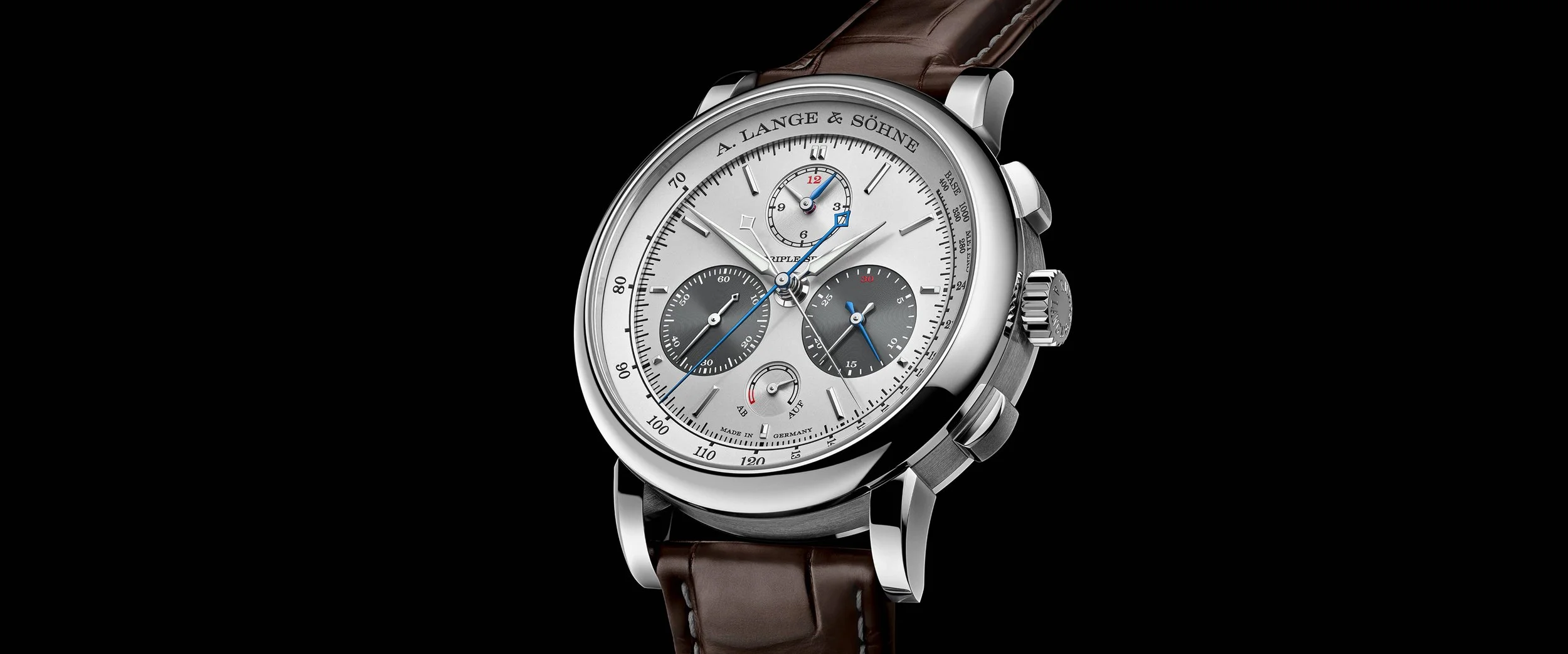
The latest Triple Split arrives in a 950 platinum case measuring 43.2mm across and 15.6mm thick.
That is not exactly small, but considering the amount of mechanical wizardry being squeezed inside, we suspect nobody at Lange lost too much sleep over the dimensions.
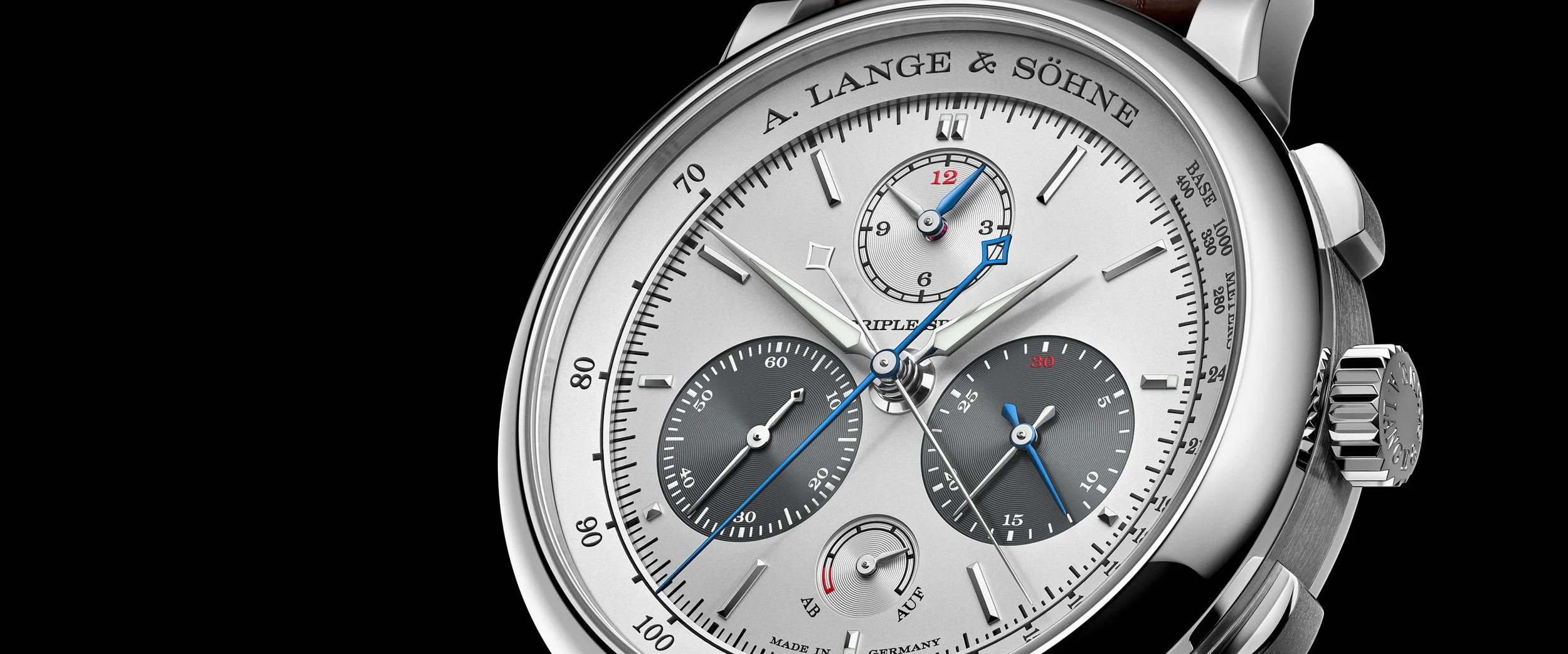
The new version has a rhodié coloured solid silver dial with darker grey auxiliary dials, creating a considerably cooler and more technical appearance than the earlier versions.
There are blued rattrapante hands, luminous hour and minute hands and small red accents around the hour and minute counters and power reserve display.
It all sounds like it should result in visual chaos, but Lange has managed to keep the dial remarkably coherent. The hierarchy of the displays is carefully considered, with the main chronograph seconds display taking centre stage.
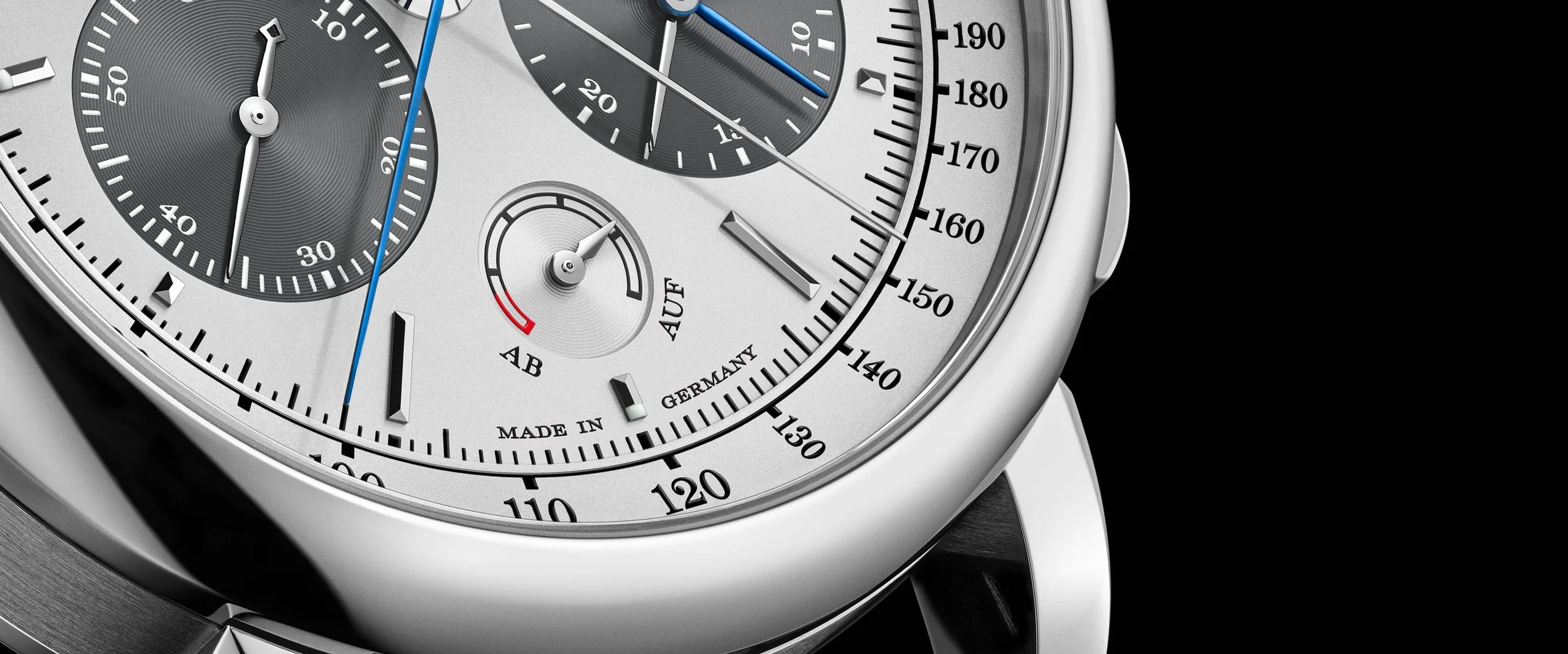
The minute counter sits at 4 o'clock, the hour counter at 12 o'clock and the subsidiary seconds display at 8 o'clock. At 6 o'clock you'll find Lange's familiar UP/DOWN power reserve indicator.
There is also a peripheral tachymeter scale capable of calculating average speeds over a distance of 1,000 metres.
The Movement Is The Real Showstopper
Turn the watch over and things get considerably more interesting.
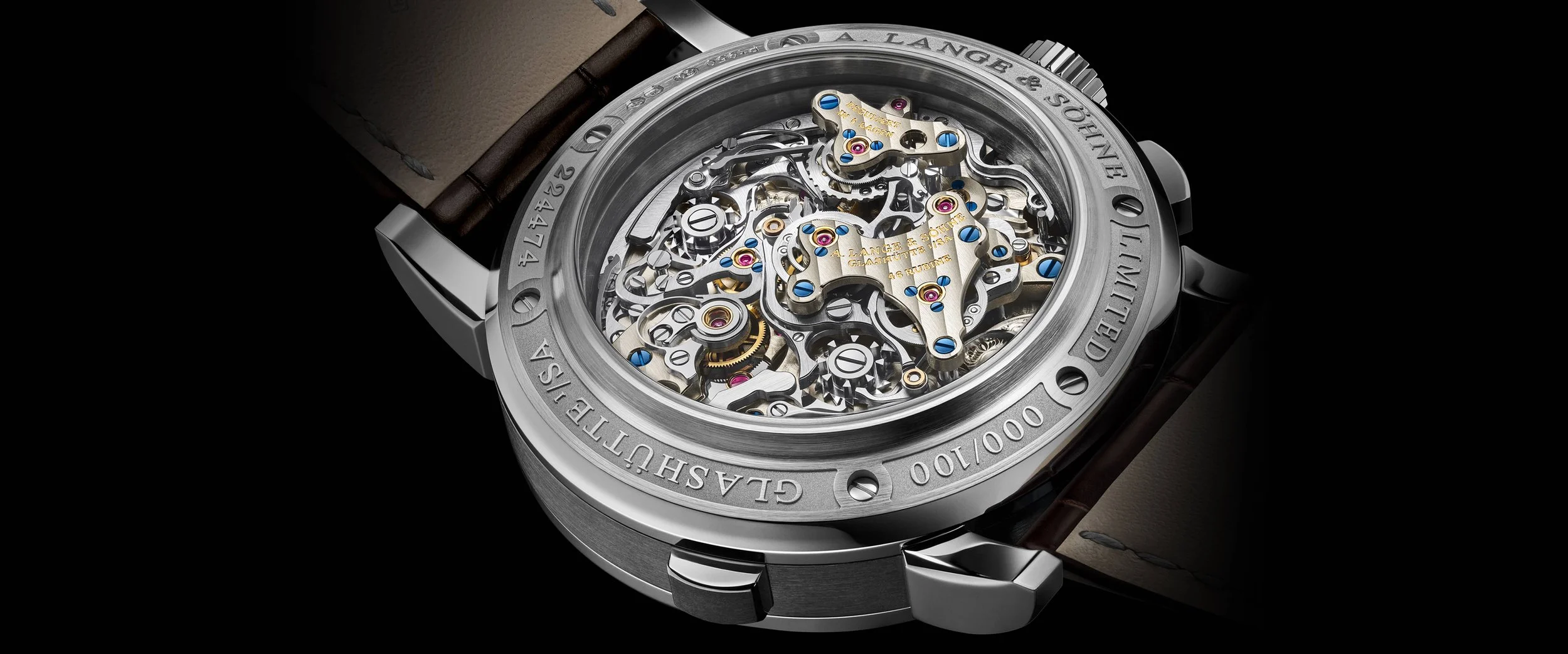
The Triple Split is powered by the manually wound L132.1 manufacture calibre, a movement containing 567 individual components.
Yes, 567.
The movement is a wonderful example of the sort of engineering that makes high end mechanical watchmaking completely ridiculous and utterly brilliant at the same time.
There are wheels, levers, springs, clutches and jumpers all working together to control three pairs of chronograph and rattrapante hands.
The movement also incorporates a patented disengagement mechanism originally developed by Lange in 2005. Its job is to reduce the friction created by the seconds and minute counter mechanisms, helping maintain a consistent supply of power to the regulating system.
In other words, even when you're asking the movement to do an absurd amount of work, Lange has engineered a way of keeping everything behaving itself.
And It Is Properly Finished
Of course, a movement containing 567 components would be impressive enough even if it looked like the inside of a washing machine.
Thankfully, this is A. Lange & Söhne.
The movement features untreated German silver bridges decorated with Glashütte ribbing, hand engraved details, five gold screwed chatons and carefully bevelled edges.
The acute internal angles are particularly difficult to finish, requiring an enormous amount of manual work.
It is the sort of movement where you can stare at the caseback for five minutes and still have absolutely no idea what half of it does.
But that is rather the beauty of it.
Six Hands Doing The Work Of Twelve
One of the most fascinating aspects of the Triple Split is just how much information is being displayed without making the dial completely unreadable.
The three standard chronograph hands and three rattrapante hands work together to allow the wearer to start, stop, catch up and reset the various measurements.
The rattrapante hands can be stopped to capture an intermediate time while the primary chronograph continues running. Press the rattrapante pusher again and the stopped hands fly back into alignment.
Do that with seconds, minutes and hours and you begin to understand why Lange describes the Triple Split as being in a league of its own.
It isn't simply a chronograph with a few extra functions bolted on. The entire movement has been engineered around the idea.
Six Days? No. Fifty Five Hours
Despite all that complexity, the L132.1 offers a 55 hour power reserve.
The movement operates at 21,600 vibrations per hour, or 3Hz, and is manually wound.
Water resistance is rated at 3 bar, which is probably sensible. If you're about to go swimming, we'd suggest leaving your £200,000 plus chronograph safely at home anyway.
Just 100 Will Be Made
The new platinum Triple Split is limited to just 100 pieces.
Lange has not published a UK retail price, instead listing the watch as price upon request.
And frankly, if you need to ask, there's a reasonable chance your bank manager will already know the answer.
The previous Triple Split models were also produced in limited numbers, with the original white gold version followed by the 2021 pink gold and blue dial version, both limited to 100 pieces. The new platinum edition continues that tradition while adding a distinctly more contemporary colour combination.
Why The Triple Split Matters
There is a temptation with watches like this to dismiss them as exercises in showing off.
And, let's be honest, there is certainly an element of that.
Nobody genuinely needs a mechanical chronograph capable of comparing multiple events over a 12 hour period. Your phone can probably do most of it while also ordering you a takeaway.
But that misses the point.
The Triple Split exists because A. Lange & Söhne wanted to see how far it could push the traditional mechanical chronograph.
The result is a movement that solves a genuinely complex problem through an extraordinary combination of mechanical engineering, traditional finishing and sheer patience.
This is not technology for technology's sake. It is mechanical watchmaking taken to its logical extreme.
The Specs
Case: 950 platinum
Case diameter: 43.2mm
Case thickness: 15.6mm
Dial: Rhodié coloured solid silver with grey auxiliary dials
Movement: A. Lange & Söhne L132.1
Movement type: Manually wound
Movement components: 567
Frequency: 21,600 vibrations per hour
Power reserve: 55 hours
Functions: Triple split seconds chronograph, flyback, power reserve indicator and tachymeter
Water resistance: 3 bar
Strap: Dark brown alligator leather
Edition: Limited to 100 pieces
Winding Things Up
The A. Lange & Söhne Triple Split is the sort of watch that makes you question whether mechanical watchmaking has perhaps gone slightly too far.
And then you remember that going too far is precisely why we love it.
The ability to compare seconds, minutes and hours simultaneously is completely excessive. The 567 component movement is completely excessive. The hand finishing is completely excessive.
And the price will almost certainly be completely excessive.
But strip all of that away and you are left with something genuinely remarkable. Lange has taken one of the oldest complications in watchmaking and fundamentally expanded what it can do.
The new platinum version doesn't reinvent the Triple Split. It doesn't need to.
It simply gives one of the most technically outrageous chronographs in modern watchmaking a new suit.
And quite frankly, it looks bloody brilliant in it.
